Health at the service of citizens, modern, agile, at low-cost and accessible to people. Is this a luxury only developed countries can afford? Imagine the possibility of the internet giving you access to your medical history; allowing you to administer your pharmacological treatments with an electronic prescription; allowing you to schedule a medical appointment without having to go to the health center, or even letting you know the estimated wait time for a specialty appointment or surgery.
The Chilean Model
These functionalities are already becoming a reality in Chile, with the launch of the Digital Hospital initiative of the Ministry of Health. Undoubtedly, this is the result of the maturity of the public healthcare system, the robustness of its health policies and, ultimately, the technological infrastructure that favors connectivity. Chile has one of the highest levels of internet use in Latin America and the Caribbean, matching connections in several European countries.
The public health system, taking advantage of the context, has recognized existent technological enablers as tools that can offer health services through a digital interface. According to the Ninth Internet Access and Usage Survey conducted in 2017, 87.4% of households in the country have their own paid access to the internet, either through mobile, fixed connections, or both. Undoubtedly, the rapid expansion of telephony has contributed substantially to facilitate this access.
The Other Side of the Coin
Despite these advances, there are two facts that should call our attention. First, access does not guarantee use, and while there is noticeable progress in access, some groups are left behind in the effective use of the internet. Second, the gaps in use are related to people’s age and income.
Suffice it to consider a few points to understand these emerging forms of digital exclusion. According to the same survey, half of the elderly who live alone have access to the internet. But if they live with other adults, even if they are older, access increases to 9 out of 10. This is encouraging from the viewpoint of access. However, regardless of their family status, half of the people aged 60 or older said they had “never” used the internet: 3 out of 10 in the richest quintile and 7 out of 10 in the poorest quintile. The main reasons given were not knowing what it can be used for or how to use it.
Older Digital Adults…?
We are probably facing a cultural change of great proportions. According to the 2017 CASEN Survey, in 10 years the number of older people who do not use the internet will have dropped from 9 out of 10 to 7 out of 10. This decrease could be considered moderate, given the rate at which information and communication technologies proliferate, and the role of the digitalization of high-impact processes in people’s daily life. Nevertheless, even as the rate of internet use among the elderly remains low, those who do use it do so on a daily basis.
On the other hand, even if they are not “digital natives”, it is possible to generate digital competences and a greater use of technology in older adults. However, working around the meaning that people attribute to the use of technology is as important as focusing on internet use competences and management skills. This has a lot to do with the perceived ease of use, as well as the specific benefits that can be obtained from it.
What is the threshold that we should overcome to achieve technological appropriation by older adults? What lessons in policy can we learn in an aspect as important as the digitalization of health?
Digitally Inclusive Initiatives
As progress is made in technological infrastructure and the development of solutions to bring services closer to people, it is essential to know the heterogeneous universe of potential digital users in depth.
The challenges in achieving digital literacy for the elderly raise an important flag for those behind new health technologies. After all, this is a very relevant group of users that will continue to demand a considerable part of health system services. Therefore, solutions must be digitally inclusive, and generating a culture of trust for optimal use of digital health technologies is equally important to the technological enablers themselves.
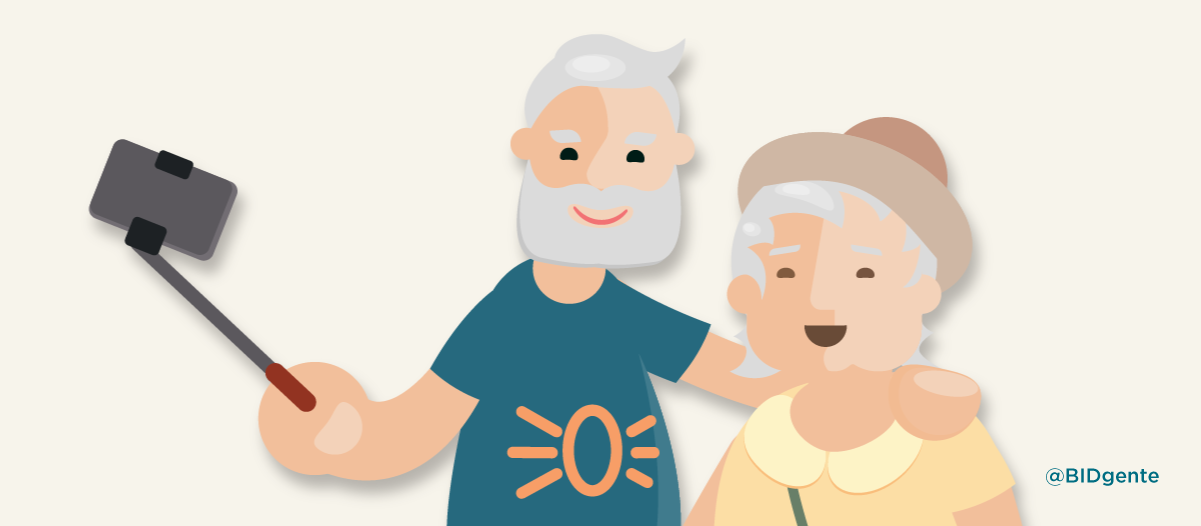
To mark the celebration of World Internet Day, Fundación Telefónica, Fundación País Digital, Travesía 100, the National Training and Employment Service (SENCE) and the IDB held the workshop “My First Selfie” with older adults in Chile. Most of them were exploring their digital equipment for the first time, and we saw them marvel at discoveries such as the possibility to schedule daily alarms to take their medications. Experiences like this should multiply so that this segment of the population can take full advantage of the benefits of technology.
What challenges for the digital inclusion of the elderly does your country face? What opportunities? Tell us in the comments or mention @BIDgente on Twitter.
The post Digital Health for Older Adults appeared first on Gente Saludable.