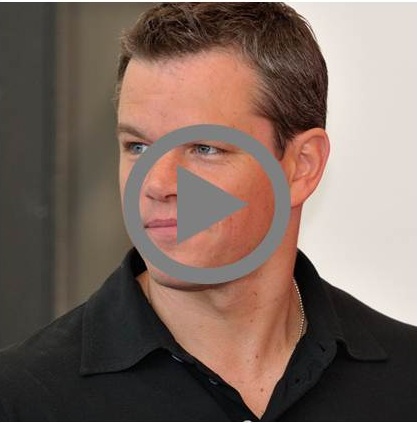
Why become an advocate for public education when you send your own children to a private school? That was the question that left well-known actor Matt Damon nearly speechless in an interview with CNN. To make an analogy, it would be like claiming to be a supporter of Michelle Obama’s campaign against obesity with a hamburger, bursting with saturated fats, in hand.
Humor and simple irony aside, I believe that many of us can honestly empathize with the problem Matt Damon is facing. Just as he does, you and I have a desire for high-quality public education. However, when it is time to make our decision, would we opt to send our children to private schools?
If you have the financial means, it is very likely that you will make that exact same choice. And as the level of your income increases, the more likely it is that this preference for private education becomes a reality. According to a recent study that surveyed homes in eight Latin American countries, the probability that a child is sent to a private school is greater than 50% for homes whose daily income exceeds $40, and where the father completed secondary school. In other words, in Latin America, when you earn a middle class income (more than $10 per day, per member of the household), almost certainly you will seek to send your children to a private school.
Why? Isn’t the answer obvious? —“So that my children can have access to a higher-quality education and to a good job.” Here we do not take into account linguistic or denominational preferences, but… have you ever asked yourself how true this is? Is it really fair that a parent’s economic success determines the quality of their children’s education? Several studies, including some in Ecuador where I work, show that the differences in standardized test scores between children in public schools and those in private schools primarily reflect differences in socio-economic status between students. In other words, if we randomly choose two students from similar backgrounds, there is no reason to think that one would have better results than the other (on average), independently of whether they go to a private or public school.
Also, the PISA study shows that the proportion of well-performing students is very low in Latin America and, assuming that those students come mostly from private schools (a hypothesis not proven, but totally believable), this implies that private schools respond adequately to the large challenge of educational quality in the region.
“I am confused!” you say. “What do I do now?” My response would be that, in the short term, demand more for what you are paying and that, in the long term, promote public education through your voice, your vote, and your tax dollars.
So that next time you cross paths with Matt Damon on the street or, more likely, with a government official (especially during elections), remind him or her that you wish you could enroll your children in a free, high-quality public school where they will be able to interact with children from diverse backgrounds.
The post Matt Damon’s Dilemma appeared first on Enfoque Educación.